Justin Hackney
The printing press was supposed to destroy the scribe’s art.
Cinema was going to kill the theatre.
Computers would flatten creativity into something cold and mechanical.
Every time one of these technologies showed up, the people closest to the old way of doing things said the same thing: this is the death of creativity.
They were wrong. What actually followed was transformation, and usually a transformation nobody saw coming. The printing press gave us the pamphlet, the novel, the scientific journal. Cinema invented an entire new language for human experience. Computers made Pixar and electronic music and eventually the internet. The friction and fear at the start were real. The golden age that came after was also real.
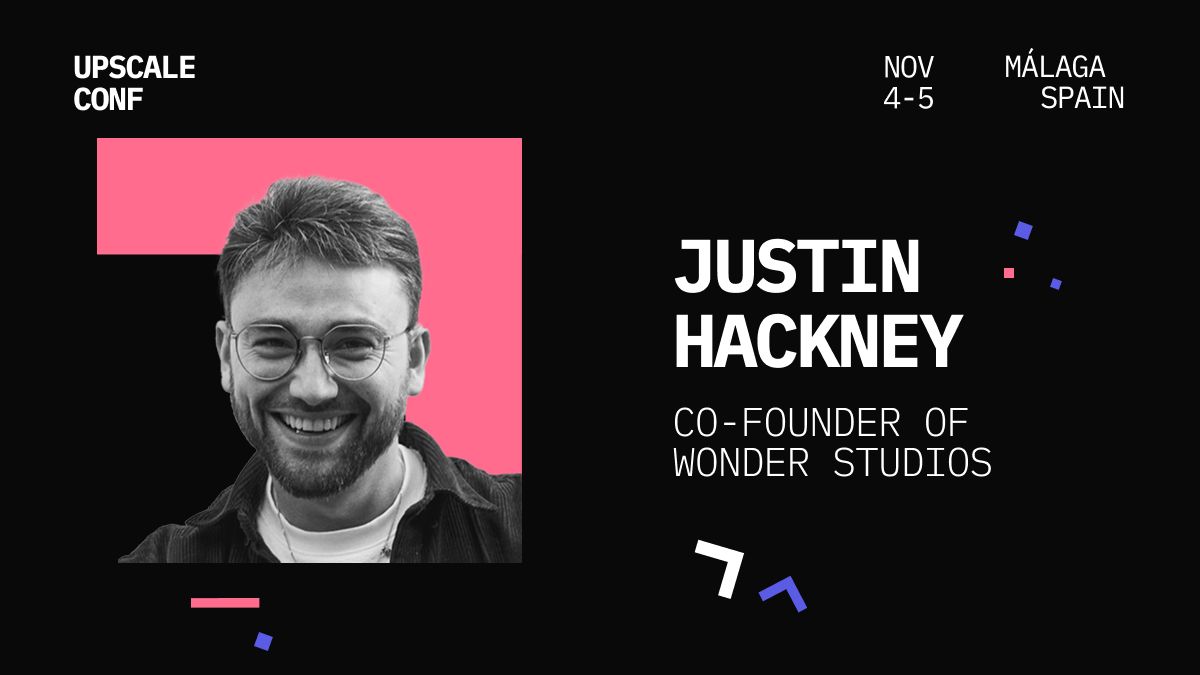
Justin’s talk at Upscale Conf 2025 in Malaga started with this historical pattern and built outward from it. His central argument: AI is following the same arc. The question worth asking is what kind of renaissance is coming, and who the people shaping it will be.
The pattern beneath every creative revolution
The framework Justin kept returning to on stage was historical. History doesn’t always hand us neat answers, but it often surfaces patterns that become hard to ignore once the dots have been joined.
A new technology arrives that dramatically lowers the barriers to creative production. The people who built their careers around those barriers panic. There’s a period of chaos where the worst fears seem justified, because the early output is crude or overwhelming or both. Then the people with real intention and real craft figure out what the new tools actually make possible. They produce work that could not have existed before. A new culture takes shape.
Cinema was so much more than plays on screen. It gave us montage, the close-up, the soundtrack - ways of moving an audience that had no precedent. Computers didn’t just accelerate what existed already. They opened up entire worlds.
The polarisation everyone is feeling right now - the fear in creative fields, the online discourse swinging between breathless enthusiasm and outright hostility - is the friction phase. Every renaissance begins in this kind of crisis. What sits on the other side of it is still being shaped.
Why abundance raises the stakes for intention
When everyone has access to powerful tools, the tools stop mattering as much. What matters is what you bring to them. Why are you making this particular thing? What do you actually want someone to feel when they experience it?
This plays out clearly once you watch enough people pick up these tools. Justin’s done this again and again through his work with OpenAI’s earliest creative testing group (twenty artists, pre-launch, everything under NDA), helping scale ElevenLabs, and now through building Wonder Studios.
A very small percentage of the work is genuinely good. That sounds harsh, but he argues it’s actually encouraging, because it proves something important: access to tools doesn’t automatically produce great work. Everyone has access to a guitar, but very few can actually play it well. The persistence to keep learning and pushing deeper is rare. The curiosity to keep asking why rather than settling for the first acceptable output is rarer still.
This is why the fear around AI is misguided. The assumption is that because the tools are powerful, the human contribution shrinks. The opposite happens. When you can generate anything, the choice of what to generate carries all the weight. If you really want to move someone - not just a quick knee-jerk reaction online, but genuinely reach them - it has to be led by intention and meaning.
Justin told the creators working on Beyond the Loop Season 1 something he believes to be true: he didn’t care about anything glossy or photo-realistic. He wanted them to pour something from themselves into it. In practice, that’s probably the hardest brief you can give someone. It means sitting with discomfort, struggling through blocks, making choices that feel risky. The creators who made those films found it painful. Any good craft is a struggle. But what came out of that struggle was real, and audiences could feel it.
What this means for creators building now
If you’re making things with AI tools right now, you’re already in a minority that is almost absurdly small. The people who show up to live events like Upscale, who experiment with workflows in their bedrooms at midnight, who keep pushing through the frustration of tools that still don’t quite do what they want are the people shaping what comes next, whether they realise it or not.
The early adopters of previous creative technologies set the standards for everything that followed. The first filmmakers invented the grammar of cinema that we still use. The first electronic musicians built genres that millions of people listen to now without having any idea where they came from. What gets made now, and how people approach making it, feeds into the culture that will grow around these tools.
Curiosity has been Justin’s drive his whole life, starting from the day he stood on the set of 28 Days Later as a kid and watched Danny Boyle work. He was supposed to be acting as a child zombie, which he’s noted is still the best job title he’s ever held. But instead of hitting his marks, he was watching the editor, trying to understand what the DOP was doing with the lens, studying how the art direction came together. He didn’t know it at the time, but he was learning that filmmaking is craft, and that craft is what separates the work that sticks around from the work that disappears.
Fifteen years of filmmaking taught him that craft compounds. Every project teaches you something you didn’t know before. Every collaboration pulls you toward a perspective you wouldn’t have found on your own. AI is adding a new dimension to that compounding, and the creators doing the most interesting work are the ones who bring years of hard-won instinct to the tools, not the ones who picked them up last week and have the most technical facility. Substance over algorithm.
Wonder as the bridge
Wonder Studios exists because there is a gap between worlds that need connecting: the traditional entertainment industry, the technology companies building AI tools, and the creators who are out there figuring out what to do with them. Wonder sits between those worlds.
“We don’t want to be disruptive. We’re not here to replace Hollywood.”
The studio works with directors and producers from the traditional world who see what these tools unlock. It collaborates with technology companies who need creative partners that actually understand storytelling. And it looks for creators, wherever they are, who have the talent and the drive to make something that means something.
Through the studio’s original films and Beyond the Loop, Wonder works directly with creators on their ideas. The model is straightforward - for the first time in history, a studio and a creator can own something fifty-fifty. You’re owning your idea instead of just selling it to someone else.
Wonder brings production support, industry relationships, financing. The creator brings the vision and the world they want to build. That’s where the fifteen million the studio has raised actually goes. The investment isn’t into anything outlandish, as Justin put it on stage. It’s invested into people. Creators who get it, who are bold enough to ask bigger questions and bring more craft and intention to what they make.
He told the audience he believes there is enough of a market for everyone to win as this space grows. Not just in entertainment as it currently exists, but in formats and industries that don’t exist yet. Whether the work that fills those spaces will have substance, or whether it will be an endless feed of disposable content nobody remembers - that’s still being decided.
This renaissance is about the people, not the technology
The printing press didn’t write the Enlightenment.
Cinema cameras didn’t tell stories.
AI won’t create the next golden age of storytelling on its own.
The people who will are the ones following their curiosity, caring about craft, sticking with the hard parts because the work matters to them.
This renaissance belongs to whoever is out there making things, experimenting, staying up too late because something almost worked and they want to figure out why. That energy is what a golden age is actually made of.
The original work coming out of Wonder show what happens when that energy meets proper studio support. Beyond the Loop documents the creative process behind it.
For creators who want to build something with real intention behind it, our community is open.
For brands who want to work with us, reach out: hello@wonderstudios.com